≡Table of Contents

Prof. Dr. Mushtaq Ahmad Khattak
CEO FIO Hospitals & Consultant Ophthalmologist
What Is Low Vision?
Low vision is significant visual impairment that cannot be corrected by ordinary glasses, contact lenses, medication, or surgery. It is not blindness. Most people with low vision retain useful sight — the challenge is learning how to use it efficiently. Common causes include advanced glaucoma, diabetic retinopathy, age-related macular degeneration, retinitis pigmentosa, optic atrophy, and corneal scarring.
How Does Low Vision Affect Daily Life?
Patients typically struggle with reading small print, recognising faces, seeing steps and kerbs, reading price tags or medicine labels, watching television, and moving safely in unfamiliar places. Central vision loss makes detail work difficult while mobility is preserved; peripheral loss does the opposite, preserving reading but making navigation risky. Understanding which pattern a patient has determines the whole rehabilitation plan.
What Happens in a Low Vision Assessment?
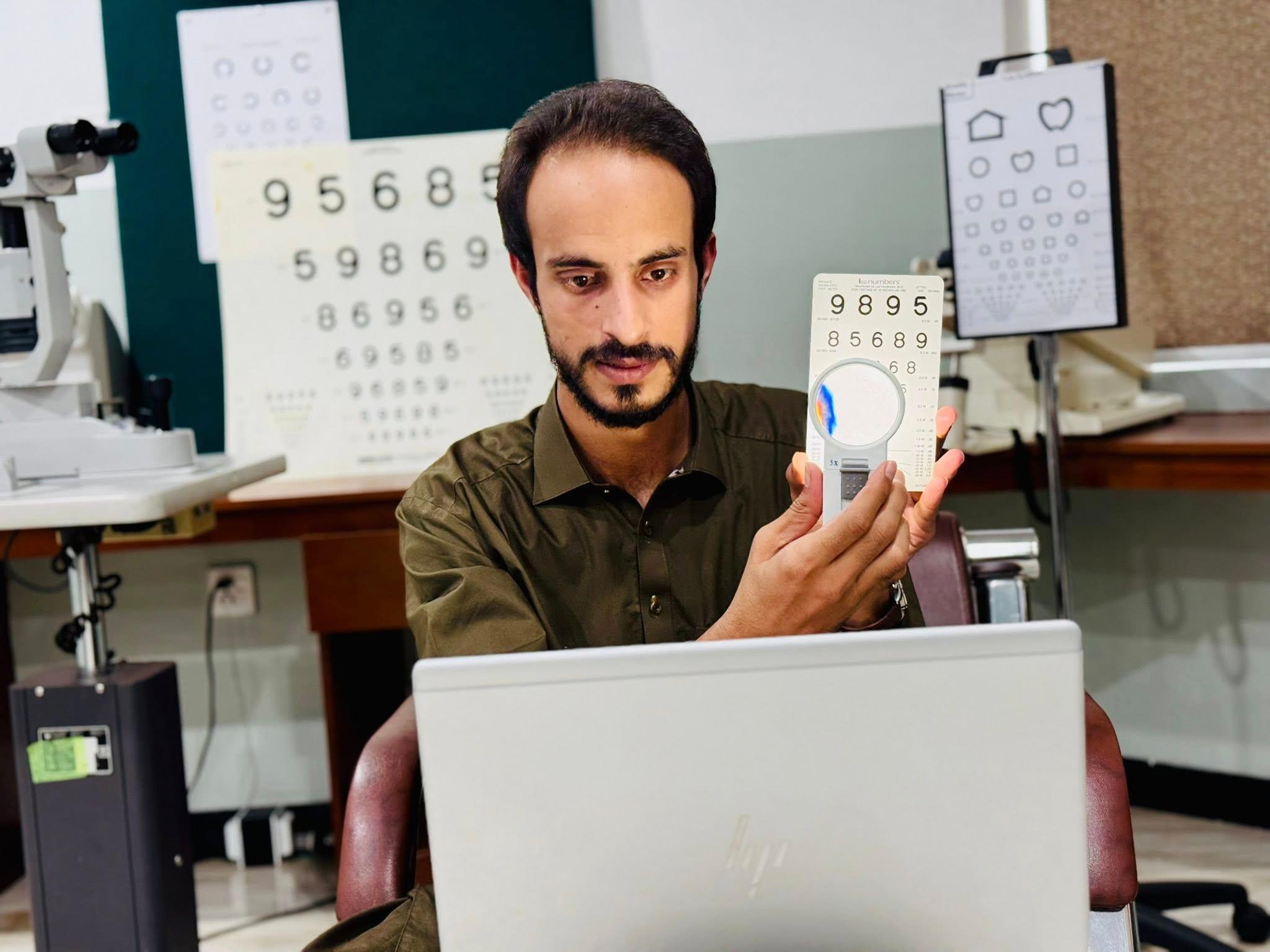
The assessment is longer than a routine eye test. We measure best-corrected acuity with specialised charts, evaluate contrast sensitivity, map the functional visual field, assess glare and lighting needs, and — most importantly — discuss the patient's own goals. Someone who wants to keep reading religious texts needs a different solution from a student using a whiteboard or a shopkeeper checking currency notes.
Which Low Vision Aids Actually Help?
Hand and stand magnifiers, high-addition reading spectacles, telescopic aids for distance, and prism correction all have their place. Electronic video magnifiers enlarge text on a screen with adjustable contrast and colour inversion, which many patients find far easier than white paper. Modern smartphones and tablets are themselves powerful low vision devices: screen magnification, bold text, high-contrast modes, text-to-speech, optical character recognition, and voice assistants cost nothing extra and are already in most pockets.
How Should You Adapt Lighting and the Home?
Simple environmental changes often help more than expensive devices. Bright, directed task lighting close to the page, matt surfaces to reduce glare, dark plates for light food, coloured tape on stair edges, large-print clocks, and decluttered walkways can transform safety and confidence at home.
What Training and Support Is Available?
Skills such as eccentric viewing — deliberately looking slightly to one side to use healthier retina — must be taught and practised. Orientation and mobility training, including safe cane use where appropriate, restores confidence outdoors. Vision loss also carries a real emotional burden; anxiety and depression are common and deserve to be acknowledged and supported alongside the practical work.
Start Low Vision Rehabilitation at FIO Hospital
Low vision rehabilitation does not restore lost cells, but it consistently restores independence. Book a low vision assessment at FIO Hospital and let our team build a plan around the tasks that matter most to you.
Book a low vision assessment at FIO Hospital, or contact your nearest branch via the appointment page.